

Can We Stop the Frequency of Heatwaves? Yes and No...


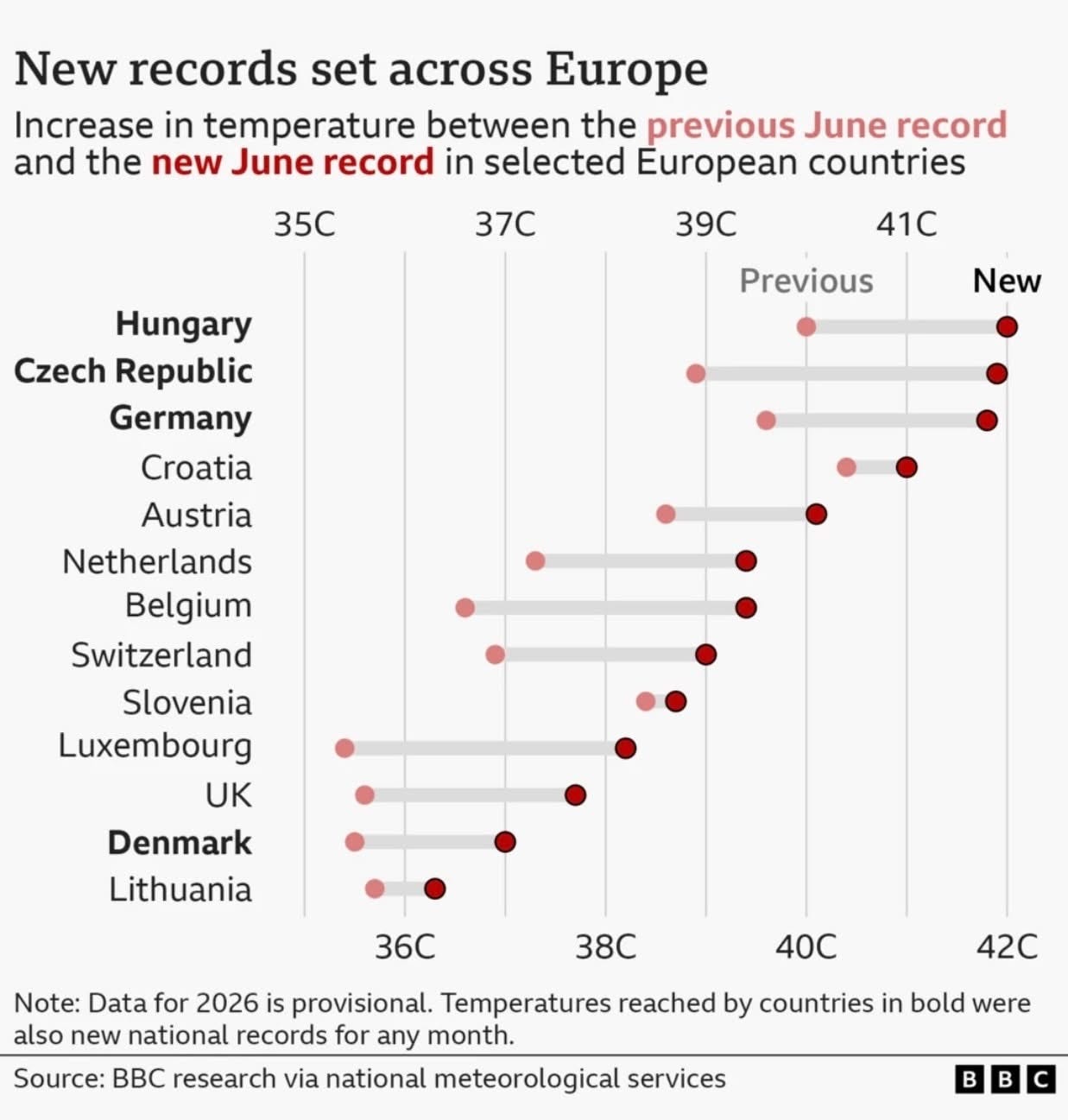
After the hottest US Independence Day ever, and record temperatures recorded across Europe, causing thousands of excess deaths, even the media has woken up to how dangerous global warming has become.
The conversation has turned to asking: “Is this normal now? Will it get even worse? Can’t we do something about this?!”
As if the crisis has sneaked up on people and shocked them by the ferocity of its bite, when in reality it’s been stretching its jaws for at least five decades. Many of us saw the snake in the grass. We shouted. We were ignored.
But here we are.
So the question is simple: Can we stop these heatwaves from happening and getting worse?
The answer? Yes and no.
‘It’s too late. The heat is already baked in’
This is the narrative that numbs progress and depresses millions. In part, it is true, but not enough to give up hope.
Let’s look at what the evidence actually says.
Our oceans have absorbed about 90% of the excess heat trapped by greenhouse gases. And yes, that heat is in the system. It will move around, but it won’t leave.
Because of this, sea level rise is guaranteed for centuries to come. Ice sheets and glaciers are melting due to the temperature we’ve already reached.
Even in a world that hit net zero tomorrow (we’ll talk about that soon), the seas would keep rising for hundreds of years.
Credible estimates suggest at least 80 centimetres of additional rise is already locked in. Anyone living on coastlines simply cannot ignore this fact.
The extreme weather that we’re living through now is also the product of warming that has already happened.
Europe is the fastest-warming continent on Earth. In the 50 years since the famous 1976 heatwave that Britain still mythologises, Europe as a whole has warmed by about two degrees.
This June’s heatwave was, according to World Weather Attribution’s rapid analysis, the most severe ever recorded over the region studied.
So yes, a hotter baseline is here. The summers of the 2020s are the new floor. That’s ‘baked in’ heat.
So does that mean all efforts to reduce global warming are futile?
This is where we find the most encouraging and, equally, most frustrating news…
When carbon dioxide emissions reach net zero, warming essentially stops.
The current scientific consensus, reflected in the IPCC’s Sixth Assessment, is that once CO2 emissions reach net zero, global surface temperatures stabilise within roughly ±0.2°C.
The oceans and land will continue to draw carbon out of the atmosphere, so CO2 concentrations start to fall the moment we stop adding to them. The leftover warming from the first process is roughly offset by the cooling from the second.
This is encouraging, because we have a solution before us. It confirms that if we reach net zero, we can genuinely start turning the juggernaut and reduce the worst case scenarios we are currently veering towards.
It’s also frustrating, because the term ‘net zero’ has been so politicised and associated with rising energy costs, that vast swathes of easily-manipulated voters are choosing the wrong people to address the damage.
Instead, their votes are giving the green light to yet more devastating CO2 production, through extra drilling for oil and gas, and continued burning of coal.
And yes, we’ve told these people. They don’t seem to believe us. This is where the communication battlefield is taking casualties. The education is out there, vast armies of it. Hitting the target is proving more difficult.
So what will work?
The solution is right there, smacking us in the face time and time again like a mismatched boxer.
Stop burning fossil fuels.
Four words which are easily said, but which seem impossible to deliver.
As much as we can all make efforts to be clean, green, low carbon machines, our individual contributions make very little difference.
Until election day arrives.
A single change of government alters the trajectory of an entire economy’s emissions for at least a decade.
The direction of traffic is not promising across the world. Fossil fuels are built in to every model of growth, for energy and for ever-increasing plastic production.
Politicians must be held to account. Also, voters.
I urge you to read these articles I have already written on the subject:


" A single change of government alters the trajectory of an entire economy’s emissions for at least a decade. " Good post. Thanks.